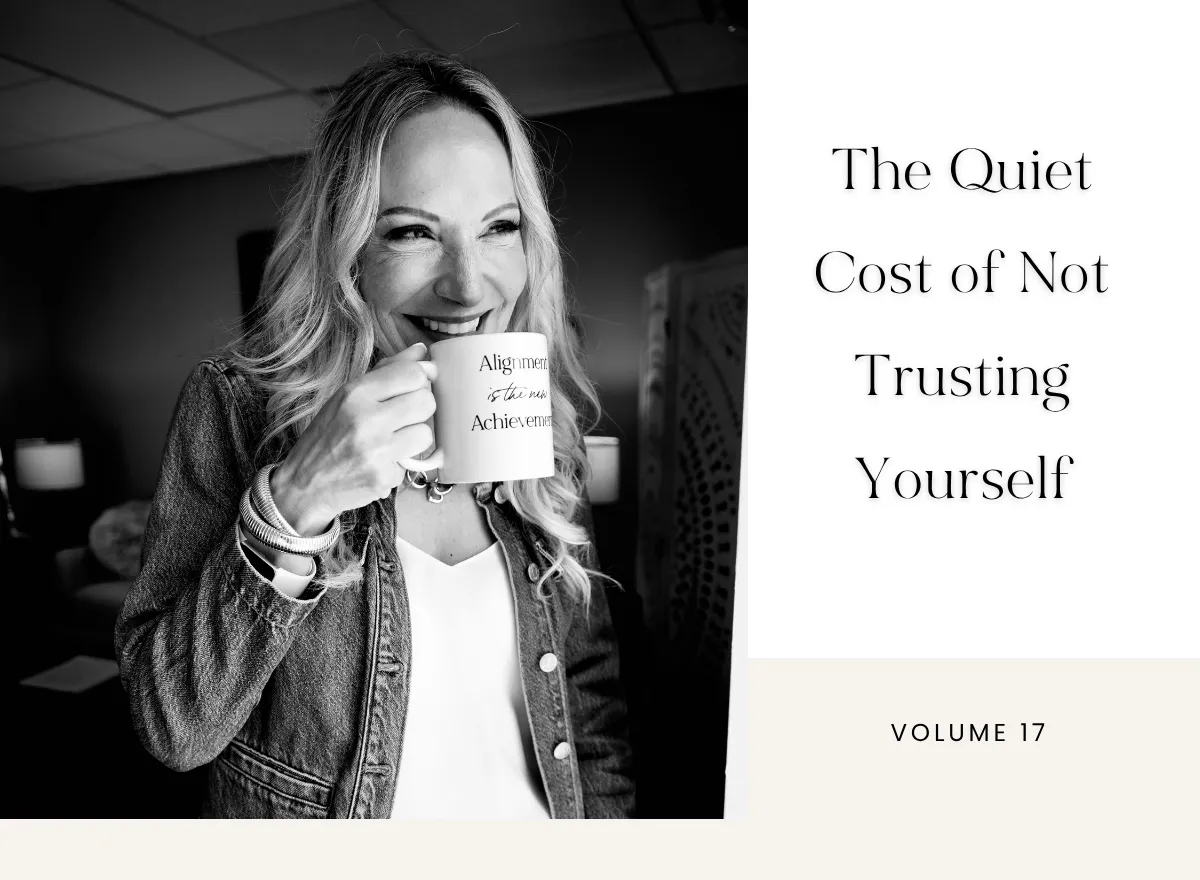
The Alignment Letter Vol. 17: The Quiet Cost of Not Trusting Yourself
Hey there,
Last month, we spent time with alignment — what it means, how misalignment shows up, and why the first step is often not a major life change, but an honest pause.
This month, we are going a layer deeper.
Because once you begin hearing yourself more clearly, another question appears:
Can I trust what I know?
That question sounds simple.
It is not.
For many capable, thoughtful, responsible people, the issue is not that they lack wisdom. It is that they have learned to question their own knowing before honoring it.
They over-ask.
They over-explain.
They delay the decision.
They look for one more opinion.
They wait for confirmation.
They keep circling a truth they already know, hoping someone else will make it feel safer to act on.
And while that may look like carefulness on the outside, it often costs more than we realize.
The Deeper Issue Underneath Self-Doubt
Here is something I have seen in myself, my clients, and many high-performing people:
When you do not trust yourself, every decision costs more energy.
Not because the decision itself is always complicated.
Because of the negotiation around it.
You know the boundary you need, but you keep softening it.
You know the yes is not honest, but you keep trying to make it work.
You know something feels off, but you ask five people before you let yourself believe it.
You know the next step, but you keep waiting until you feel completely certain.
That daily negotiation is exhausting.
It is not just the decision that drains you.
It is the constant re-checking.
The second-guessing.
The over-explaining.
The seeking of permission.
The quiet habit of treating everyone else’s read as more valid than your own.
And over time, that pattern weakens self-trust.
Not all at once.
Slowly.
Every time you know something and do not honor it, you teach yourself that your knowing is negotiable.
Every time you override the signal, you make it harder to hear the signal next time.
Every time you ask someone else to confirm what you already know, you move your authority a little further away from yourself.
This is not about never asking for help.
It is not about refusing feedback.
It is not about being impulsive, isolated, or unwilling to receive wisdom.
Healthy counsel matters.
Support matters.
Perspective matters.
But there is a difference between seeking wisdom and abandoning your own inner authority.
That distinction matters.
The Reframe to Carry This Week
Here is the one thing I want you to walk away with from this letter:
Self-trust is not certainty.
Self-trust is not always knowing exactly what to do.
It is not never feeling fear.
It is not making every decision perfectly.
It is not having a complete plan before you move.
Self-trust is the practice of listening to what you know, honoring what you need, and choosing one aligned next step without constantly outsourcing your truth.
Sometimes self-trust sounds like:
I need to pause before I answer.
I know this yes is not honest.
I do not need to over-explain this boundary.
I can receive input without handing over my decision.
I can be afraid and still tell the truth.
I can move with wisdom even without perfect certainty.
Self-trust is not built in one dramatic moment.
It is built through honored decisions.
One truth named.
One boundary kept.
One pause before the automatic yes.
One decision made from alignment instead of fear.
One moment where you stop asking everyone else what something in you already knows.
That is how self-trust begins to rebuild.
A Place to Begin: The Self-Trust Check-In
This month, I created a free resource to help you begin there.
It is called:
The Self-Trust Check-In
10 Questions to Reconnect with Your Inner Knowing and Make One Aligned Decision
It is a simple reflection guide for the person who keeps second-guessing, over-asking, over-explaining, or waiting for permission before honoring what they already know.
It is not designed to rush you.
It is not designed to push you into a dramatic decision.
It is designed to help you pause, listen, and identify one aligned decision you can honor this week.
Because sometimes the next step is not gathering more opinions.
Sometimes the next step is coming back to yourself.
Reflection Practice
This week, take ten quiet minutes and ask:
What do I already know that I keep asking others to confirm?
Then write one sentence:
One aligned decision I can honor this week is___________________.
Keep it small.
A boundary.
A pause.
A no.
A yes that is actually honest.
A conversation.
A decision to stop over-explaining.
A commitment to wait before answering.
A choice to trust your read on a situation.
Self-trust is not built by thinking harder.
It is built by honoring what you know, one decision at a time.
Download: The Self-Trust Check-In
Go Deeper: The Alignment Letter will continue exploring self-trust this month — especially what happens when we keep asking everyone else what we already know.
You do not need perfect certainty to begin.
You need one honest decision you are willing to honor.
With clarity,

Executive Coach | Alignment and Performance Strategist | Leadership Advisor
P.S. — August is about The Practice of Self-Trust. Not as a vague idea, but as a lived practice: listening sooner, honoring what you know, and rebuilding trust through small decisions you actually keep.
Follow:@ChristineADaniels| Watch:The Architect's Voice(YouTube) | Subscribe:The Alignment Letter|All resources

Copyright© 2026
All right reserved
Christine A. Daniels LLC
If you no longer wish to receive these emails you mayunsubscribe.
